
SMAS vs. Deep Plane Facelift: Philadelphia Plastic Surgeon Explains the Difference (With Video!)
If you want to restore a youthful appearance in the face, a Philadelphia facelift generates a stunning improvement. The “after” photos reveal sweeping jawlines, youthfully high cheekbones—all completely natural-looking. But the first question that every Philadelphia patient asks is this: what’s the difference between a deep plane facelift and a SMAS (traditional) facelift?
Keep reading to learn what sets the deep plane technique apart, and watch the video below for Dr. Claytor’s demonstration with visuals!
Philadelphia plastic surgeon Dr. Brannon Claytor explains how the deep plane facelift technique differs from the more common SMAS plication facelift.
Show transcript »
Dr. Claytor here, sharing with you what a deep plane facelift is and how it generates that kind of improvement.
So here we have our lovely patient—her before and her after. Her biggest frustration is her neck and her jowls that have come down. What she’s looking for is a more youthful return to her previous self, and that’s really what we’re after. We’re not about changing people and making them look different. We want them to be the best version of themselves.
What happens when we age is we get facial descent. Our malar eminence—our bone here—it involutes and everything drops down. So what we start to see is downward descent of our face, and that is exhibited not only in jowling down here, but also in excess neck fat and skin down here. It’s very, very frustrating, and patients come in frequently saying, “Listen, this is not who I am. I look in the mirror and I don’t see myself.” And actually, in the profile view, it’s even worse.
So the goal of this operation is to rejuvenate the patient’s aging elements—to go into the face and lift back vertically what had been falling down inferiorly. The way we do this is with very small incisions that are hidden along the ear, what we call the hairline and the sideburn region. Then these come back and they’re hidden behind the ear, and then they come down along the hairline there so that they’re very well disguised. Not infrequently, I will also go up into here, which gives me access to be lifting in that orientation.
That takes us to: what is the difference between a SMAS plication and a deep plane facelift? That question comes up every single time a patient comes in for a consultation, and so it’s a great question. We’re going to answer it here.
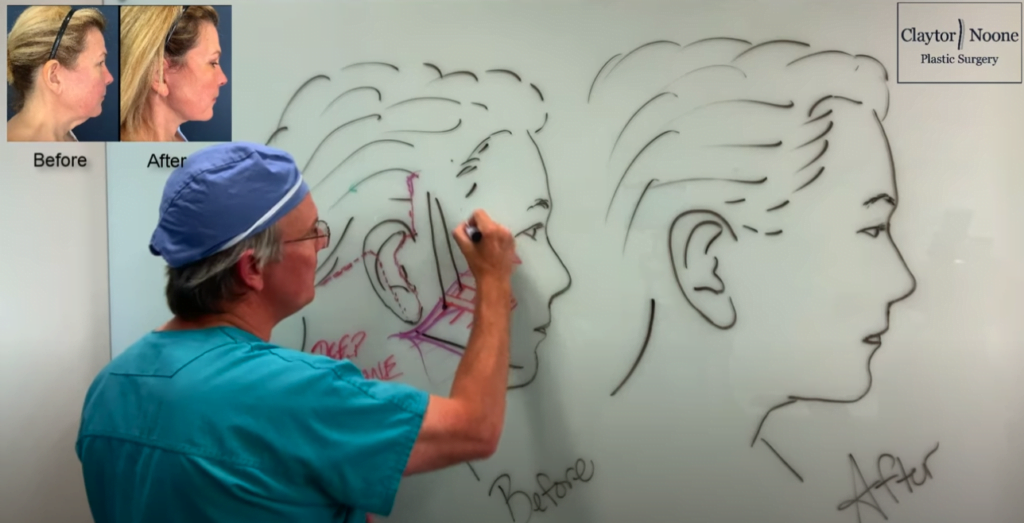
Here we have our platysma muscle in our neck. It really has no function other than being a muscle of animation—you move it around and you can see your neck muscles move. It has nothing to do with actually moving your head. Right along here is our mandible, and the mandible comes down along here. Below the mandible is where you have your platysma muscle. Above the mandible is where you have your SMAS muscle, which stands for Superficial Musculo-Aponeurotic System.
So you go from skin to SMAS, down to the muscle, and then you go down deeper to the bone.
When people have a SMAS plication, what’s happening is the SMAS aspect of it is lifted and plicated up here, and it’s for a very superficial lift. You’re really only getting about that much lift. Some people will go down here with it and allow the whole area to lift up, but that’s what a SMAS plication is.
In the deep plane lift, what we’re doing is we are going underneath that SMAS. This SMAS is continuing up here, and so you’re making the incisions that we’ve marked here. We’re lifting up that tissue, we’re moving in underneath the skin layer, and then we’re coming up to this SMAS. What we do in the deep plane lift—so this is the deep plane—is that we make the incision pretty much from the lateral aspect of the eye down to the corner of the jaw, sort of in this orientation. That’s where we make the incision down into this SMAS to go up underneath it. So that’s the deep plane aspect of it.
While we’re there, we come across these retaining ligaments. These are very, very stout ligaments that sit here and here and here, and they’re what keep the face’s soft tissue from being advanced superiorly. They’re sort of, if you will, giant stakes in the ground that are preventing anything from moving around.
So we need to go in first in the deep plane dissection and dissect into the spaces in between these retaining ligaments. We dissect down into here, we dissect down into here, and we dissect down into here, so those tongues, if you will, are opened up. Then we can very clearly see what’s going on, and we come across the retaining ligaments as we try to connect these two.
What makes this operation so challenging are the facial nerves that are traveling in this area. They are very delicate, they’re very small, and they need to be treated with tremendous caution. Interestingly, the nerves run very close to the retaining ligaments, so as you’re releasing the retaining ligaments, you need to be looking for the very delicate facial nerves. The facial nerves come out from underneath the ear into a pattern that’s somewhat like this.
So you can see that the deep plane facelift basically goes right along where the facial nerves are moving from behind the ear out into innervating the facial musculature. And again, this is what makes this operation so incredibly technically challenging.
But if you can understand these different tongues that are advanced in between the retaining ligaments and then, therefore, allow connection between these two to further release and identify and remove these retaining ligaments—once these retaining ligaments are released, now this entire area is very mobile and can be repositioned.
If you look at people on a three-quarter view, patients who have a very high cheek area have a very youthful and aesthetic appearance. When we age, that cheek area drops down. In that three-quarter view, you see that area drop down and then it bunches up down here in the jowls, which is really what gives you that aged appearance.
So by mobilizing this SMAS after you’ve released the retaining ligaments—remember I said that this area gets lifted—imagine that this entire area is now lifted up this way. Now sutures can be attached once these areas are connected and the retaining ligaments have been released and you’ve very delicately worked around the facial nerves and left them intact. Now the sutures can be secured here and up here, and that’s what takes this tissue and elevates it superiorly. That’s what creates the tremendous power and effect of the deep plane facelift.
If we move over to our after patient, why does she look different? She looks different because all of these tissues have been moved up and we’ve been able to reposition her malar eminence back in a more youthful position. That’s part of it.
The other part of it is down in the neck. How do we create this beautiful jawline? Well, the way you do that is by coming down along the mandible here and releasing that platysma muscle—again, needing to be very careful of the facial nerves. But these are similarly, just like these tongues into and underneath this SMAS, this is released along here, generally almost to about the corner of the mouth or what we call the marionette line. So the release of the platysma is all the way along to there. By releasing that, now you’re able to take this platysma muscle, which is part of the hanging, sagging skin of the neck, and lift it and reorient it. In addition, all the fat that’s in here is removed—so all that excess fat we take out.
Now once that’s released, the muscle is then elevated and secured back here, back into the mastoid fascia, and that’s what creates that incredibly powerful, strong neckline. The jawline—there’s the mandible. Now that muscle which used to go this way, now the muscle comes up here and it’s very nicely secured back to the mastoid fascia here.
So with the platysma muscle section underneath the jawline, that creates this gorgeous, sharp neckline and incredibly well-defined jawline. In combination with this SMAS now being elevated superiorly and secured in this orientation, it gives you a 5-10 year lifting result of rejuvenating and refreshing and giving you that youthful appearance.
So the big difference again between SMAS plication and the deep plane facelift is: in SMAS plication, you’re really just reefing up a small portion and you’re not releasing the retaining ligaments. As opposed to the deep plane facelift, you’re going in underneath this SMAS, you’re identifying the facial nerves, you’re identifying the retaining ligaments, and you’re releasing the retaining ligaments.
I can’t stress enough—really, the biggest difference between SMAS plication and the deep plane facelift is the ability to release those deep retaining ligaments. And that’s what gives you that very sustainable and dramatic lift and addresses the jowl and addresses the cheek region and gives you that youthful shape back to your face.
I hope you found this helpful. Looking forward to making more of these videos to help explain some of these complex issues that are becoming more commonplace when patients come in and they’re bringing up topics. Patients are coming in today much more educated, and it’s so fun to be able to share this information in a digestible form so that when you come in, you’ve got a framework to ask the questions as you’re looking for your rejuvenation journey.
Thanks so much.
SMAS plication facelift
The most common type of surgical facelift, an SMAS plication facelift works on a shallower layer of tissues than the deep plane facelift. The SMAS is the superficial musculoaponeurotic system below the skin in your mid-to-lower face. “Plication” is the term for a surgical tightening of tissues, which usually involves lifting, removing excess, and rejoining remaining tissues. In a SMAS plication facelift, the SMAS layer is lifted vertically and re-anchored in front of the ears to create a lift of about 1 cm. Some surgeons may also lift from further down into the cheek, at the front of the earlobe, for expanded effects. Still, even an expanded SMAS facelift procedure cannot compare with the more comprehensive improvements offered by a deep plane facelift.
Deep plane facelift, step by step
A deep plane facelift leaves the SMAS intact, instead requiring your surgeon to access deeper attachments in the cheeks and lower face to raise and tighten tissues. Here are three major steps in the surgery:
1. Incisions are made within the hairline and in the natural folds of the ear.
A deep plane facelift is performed through discreet incisions placed in the sideburn area, within the folds of the ear, and along the hairline behind the ear at the back of the neck.
Not infrequently, Dr. Claytor will also create an incision within the hairline above the ears (just behind the temple); this allows him to lift the SMAS of the face at another important vertical axis, which may be more beneficial for certain patients.
2. The SMAS is separated, retaining ligaments are released, and the tissue is anchored higher for a defined cheek and firmer jowl area
SMAS is surgically separated from underlying tissues to allow Dr. Claytor to reach the retaining ligaments. These ligaments have a strong hold on the tissues of the cheek and lower face, keeping tissues in position. Thus, Dr. Claytor releases them in order to be able to lift the skin, fat, and SMAS higher on the facial bone structure. The skin is sutured gradually in the newly raised position, and anchored above the ear.
Ligament release is the primary step that makes the deep plane facelift so different from the SMAS technique: it allows for more impactful, dramatic results because the cheek’s youthful, high shape—a.k.a. the malar eminence—can be more fully restored, resulting in a stunning, youthful sweep in the mid-face.
3. Neck bands are released and anchored higher for a chiseled jawline.
In the neck, rather than SMAS, you have the platysmal muscles located below the ear, beneath the mandible, and toward the front of the neck. These muscles form the tight, vertical lines you see at the front of your neck when you clench your jaw (they don’t affect how you move your head).
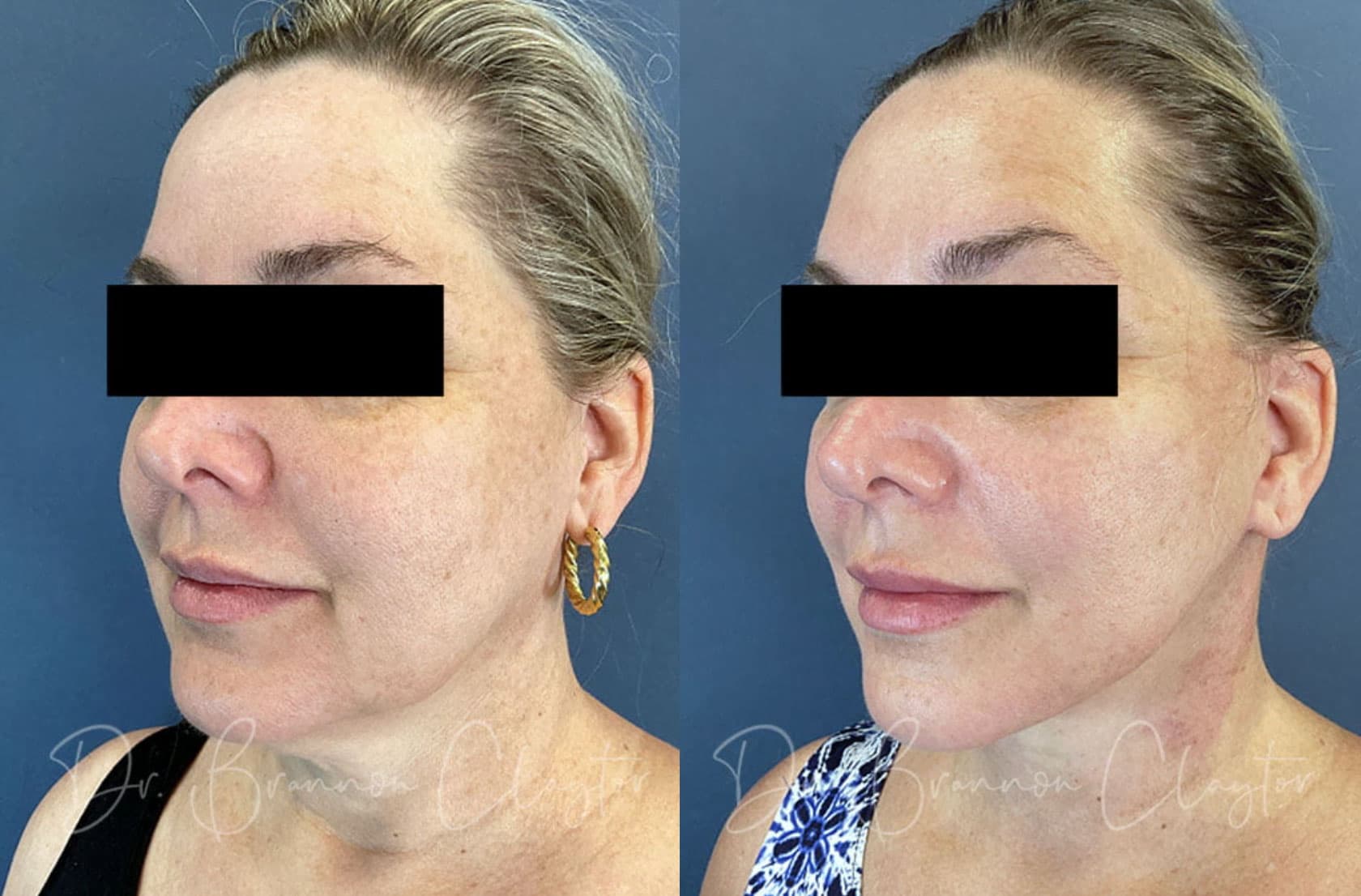
To create a sweeping, more youthful jawline appearance, the platysma is released along the jawline, allowing Dr. Claytor to anchor these muscles behind the ear. This can create a chiseled mandible or jawline, as you can see in this before and after photo:
The importance of an experienced, expert deep plane facelift surgeon
A deep plane facelift works on the same layer of tissues where your facial nerves lie. Nerves spread from below and behind the ear, out into the cheeks, jawline, and below the eye area. The nerves that thread throughout the facial ligaments are released in a deep plane facelift, so it’s critically important that your surgeon is well-versed in this anatomy and in techniques for maintaining the integrity of facial nerves. Once a surgeon dissects below the SMAS layer of the face, they must identify and very delicately operate around the nerves.
Do not settle when it comes to choosing a board-certified plastic surgeon: avoid surgeons who offer below-average pricing, or who don’t have the before and afters, reviews, plastic surgery credentials, and reputation that prove they can safely achieve excellent facelift results. Dr. R. Brannon Claytor teaches his deep plane facelift technique at national meetings of plastic surgeons, and is widely considered to be a deep plane expert.
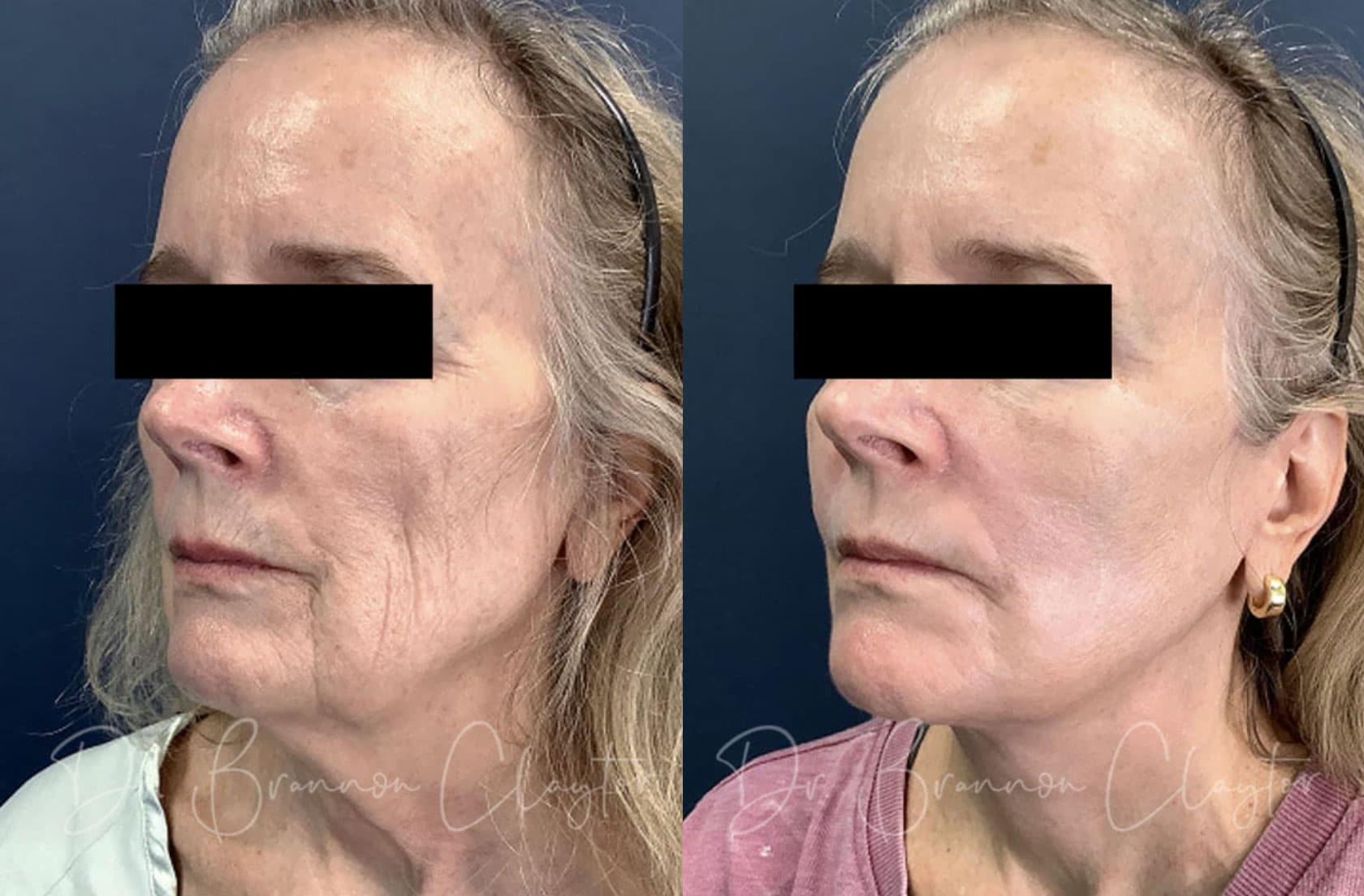

“The whole experience was fantastic! The results exceeded my expectations! I look and feel 10 years younger. Dr. Claytor and his staff made me feel so at ease and comforting. He is an excellent surgeon with a wonderful bedside manner and personality. It is one of the best decisions I ever made. I would highly recommend Dr. Claytor; in fact my neighbor has an appointment with him next month.”
Should I consider a deep plane facelift?
Patients who are good candidates for deep plane facelifts often come to us with loose skin that has succumbed to gravity, including forming jowls (loose skin around the jawline and chin) and sagging in the neck. As we age, we experience facial descent: our cheek structure (malar eminence is the technical term) involutes, and what we start to see is downward descent of our face—creating jowling, and excess neck skin and fat.
A good candidate for this procedure is looking to return to a more sculpted jawline and reduced wrinkles. Dr. Claytor’s goal is to help you look like the best version of yourself: We’re not here to make you look like someone else!
If you’re ready to experience these rejuvenating results yourself, we’d love to meet with you to discuss options! Dr. Claytor serves patients from all over the Bryn Mawr, Main Line, & Philadelphia areas. Call 610.527.4833 or contact our Philadelphia plastic surgery practice online to schedule your personal consultation with Dr. Claytor today.